
Characters
Character relationship maps for web novels: what to write before the lines
Instead of labeling lines as friend, family, or enemy, connect desires, secrets, leverage, and turning points by episode.
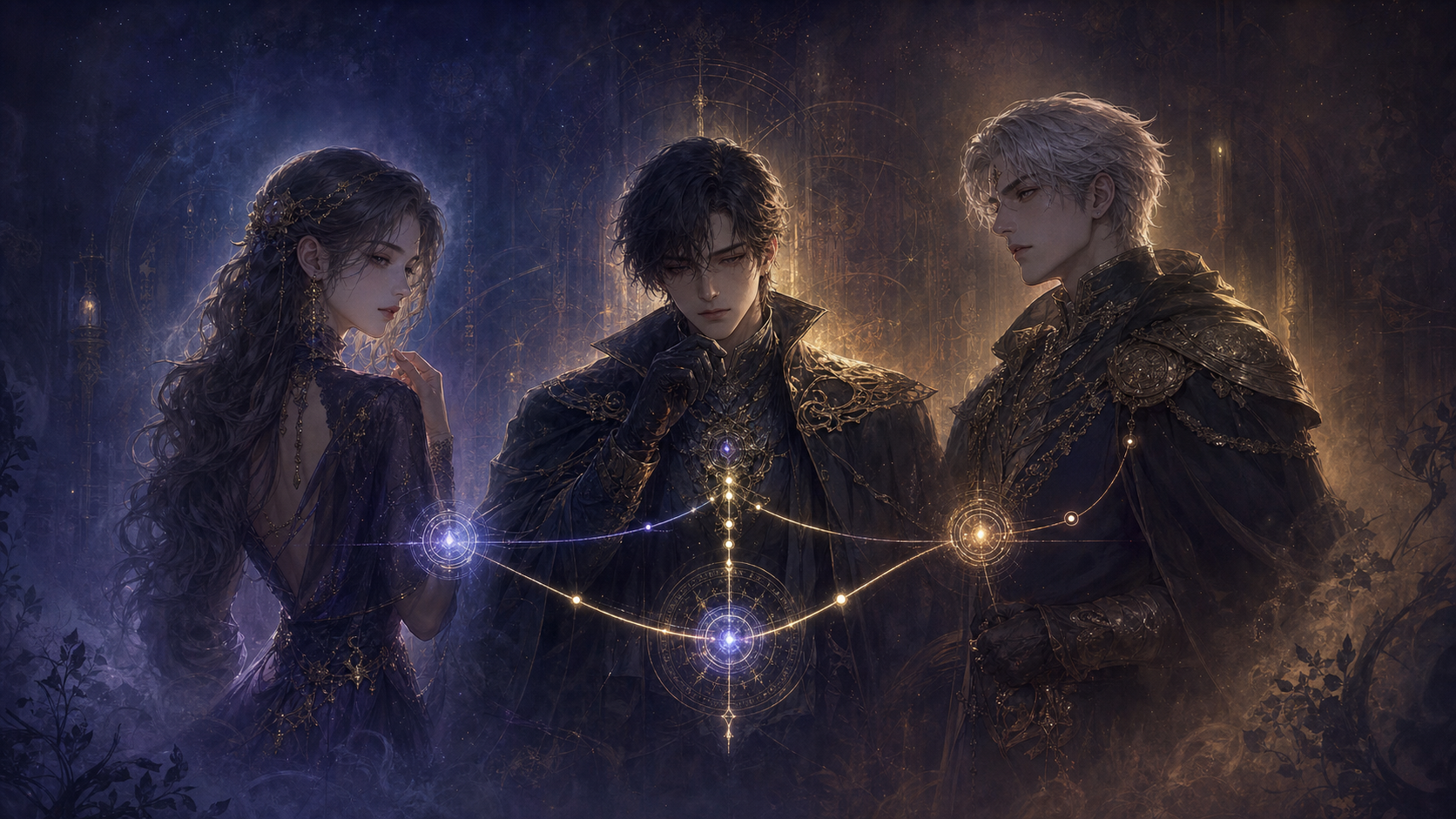
There is a simple reason a relationship map can still leave you confused.
The lines only say friend, family, or enemy.
Even between friends, one person may want to return to the old days while the other wants to leave while hiding a secret. When people want different endings, the temperature of the scene changes completely even if the relationship label looks the same.
A web novel relationship map is not a character profile sheet. It is closer to a scene design map that lets you quickly check who wants what, who holds information, and which event changed the relationship.
Write each side's desire, not only the name of the relationship
If two characters are connected by a line, do not end with one word. Split the arrow both ways and write what each person wants from the other.
- Yunseo -> Haejin: wants to remain partners and finish the mission together.
- Haejin -> Yunseo: wants to pull Yunseo out of the organization even if the mission is abandoned.
They are on the same side. But they want different endings. Yunseo wants to keep the bond; Haejin may cut the bond to keep Yunseo alive.
Once that difference is visible, the dialogue changes. Yunseo can say, "Let's go together to the end," while Haejin may draw a cold line on purpose. Looking at the map should suggest the conflict in the next scene.
For secrets, who knows matters more than the content
Emotion is not the only thing that moves relationships. Information changes who controls a scene.
Summarize one relationship as a short card.
Yunseo <-> Haejin They appear to be partners in the same investigation unit. Yunseo does not know Haejin is a royal spy. Haejin holds evidence that can clear Yunseo's name. In the current negotiation, Haejin has the advantage.
The key is not simply "Haejin is a spy."
- Haejin knows his own identity.
- Yunseo does not.
- The reader may or may not know.
- Haejin holds evidence Yunseo needs.
The same secret can create suspense, a twist, or a misunderstanding depending on who knows it. When you write a secret on the map, always include its disclosure range.
Record emotional change as events, not results
If you only write "became enemies after being friends," you will later forget why the emotion changed. Record the event that moved the relationship, with the episode number.
- Episode 4: Haejin saves Yunseo. Caution -> temporary alliance.
- Episode 11: Yunseo finds spy documents. Trust -> suspicion.
- Episode 16: The documents are revealed to be forged. Suspicion is cleared, but Haejin's lie remains.
As the last line shows, emotions rarely move one clean step at a time. Suspicion can be resolved while hurt remains. A character can love someone and still not trust them.
When the change event is recorded, it becomes easier to decide how close their speech should be in the next episode and which actions they will allow. It also reduces sudden emotional reversals.
Leverage can change from scene to scene
Even when the relationship is the same, control of the scene keeps moving.
Mark who currently holds each of these:
- authority to command
- money or resources
- the other person's weakness
- evidence about the incident
- the option to leave first
- less to lose emotionally
A king may outrank a retainer, but a retainer who knows the king's secret can control the conversation. In romance, the person who loves more is not always weaker. The direction of power changes depending on who can walk away.
That is why it is more practical to write who has the advantage in the current scene than to draw a fixed hierarchy.
Compress the current state into one sentence
As episodes accumulate, rereading relationships takes longer. Summarize the state at the last turning point in one sentence.
As of episode 16: Yunseo wants to trust Haejin again, but Haejin fears the alliance will end if he reveals that he is a spy.
That one sentence contains both desires, the unresolved secret, and the direction of the next conflict.
After finishing an episode, you do not need to redraw the entire map. Check only three things.
- Did any character learn a new secret?
- Did the balance of power change?
- Was there an event that made the relationship different from before?
If one of the three changed, update only that relationship.
When there are many characters, focus on this scene's connections
Once three or more people are involved, you may want to put every line on one screen. But the more lines you draw, the harder it becomes to find the relationship you need.
Expand only the connections that affect the current scene.
- Yunseo - Haejin: rebuilding trust. Yunseo does not know Haejin's identity.
- Haejin - Regent: pretends to obey while gathering proof of treason.
- Regent - Yunseo: uses the false accusation to control the investigation unit.
These three lines show how the Regent's order moves through Haejin and changes Yunseo's choice. A relationship map should not be a pretty finished picture. It should be a tool for pulling out the information needed to write the scene.
In Baroro's Wiki and relationship view, the source setting remains editable by the author. The relationship screen is a faster way to read those records, while the original is the setting document the author manages.
If places or power rules are also becoming tangled, start with separating confirmed facts from ideas in worldbuilding management that does not shake as episodes accumulate.
A good relationship map is not the one with the most lines. It is the one that lets you answer, before writing the next scene, who wants what, what they are hiding, and who currently has leverage.
Create a new work in Baroro and start by organizing the relationships among three core characters.